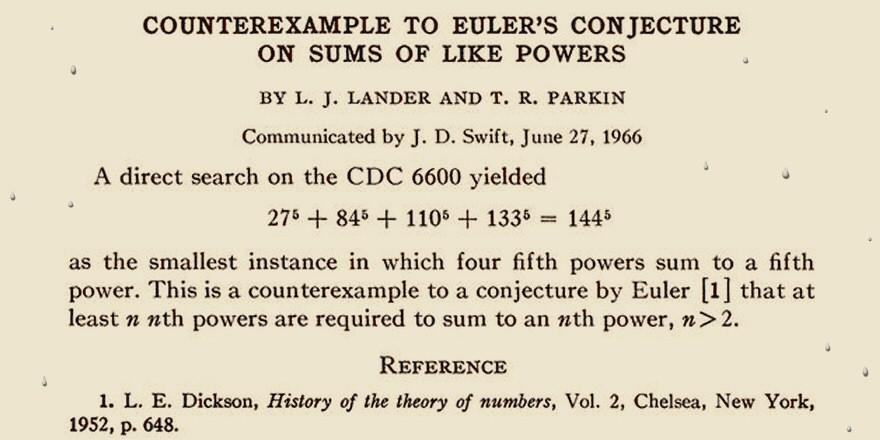
The Shortest-Known Paper Published in a Serious Math Journal: Two Succinct Sentences

shortest math paper

Euler's conjecture, a theory proposed by Leonhard Euler in 1769, hung in there for 200 years. Then L.J. Lander and T.R. Parkin came along in 1966, and debunked the conjecture in two swift sentences. Their article -- which is now open access and can be downloaded here -- appeared in the Bulletin of the American Mathematical Society. If you're wondering what the conjecture and its refutation are all about, you might want to ask Cliff Pickover, the author of 45 books on math and science. He brought this curious document to the web back in 2015.

Would you like to support the mission of Open Culture? Please consider making a donation to our site. It's hard to rely 100% on ads, and your contributions will help us continue providing the best free cultural and educational materials to learners everywhere.

Also consider following Open Culture on Facebook and Twitter and sharing intelligent media with your friends. Or sign up for our daily email and get a daily dose of Open Culture in your inbox. 

Related Content:

60 Free Online Math Courses

Free Math Textbooks

The Math in Good Will Hunting is Easy: How Do You Like Them Apples?

Does Math Objectively Exist, or Is It a Human Creation? A New PBS Video Explores a Timeless Question

The Shortest-Known Paper Published in a Serious Math Journal: Two Succinct Sentences is a post from: Open Culture. Follow us on Facebook, Twitter, and Google Plus, or get our Daily Email. And don't miss our big collections of Free Online Courses, Free Online Movies, Free eBooksFree Audio Books, Free Foreign Language Lessons, and MOOCs.


from Open Culture https://ift.tt/2v9SQmB
via Ilumina

Comments

Popular posts from this blog

When Albert Einstein & Charlie Chaplin Met and Became Fast Famous Friends (1930)

Photo via Wikimedia Commons “You do not really understand something unless you can explain it to your grandmother,” goes a well-known quote attributed variously to Albert Einstein, Richard Feynman, and Ernest Rutherford. No matter who said it, “the sentiment… rings true,” writes Michelle Lavery , “for researchers in all disciplines from particle physics to ecopsychology.” As Feynman discovered during his many years of teaching , it could be “the motto of all professional communicators,” The Guardian ’s Russell Grossman writes , “and especially those who earn a living communicating the tricky business of science.” Einstein became one of the world’s great science communicators by choice, not necessity, and found ways to explain his complex theories to children and the elderly alike. But perhaps, if he’d had his way, he would rather have avoided words altogether, and preferred acrobatic feats of silent daring to get his message across. We might at least conclude so from his reverence f...

A 10 Billion Pixel Scan of Vermeer’s Masterpiece Girl with a Pearl Earring: Explore It Online

We admire Johannes Vermeer’s  Girl with a Pearl Earring   for many reasons , not least that it looks exactly like a girl with a pearl earring. Or at least it does from a distance, as the master of light himself no doubt stepped back to confirm countless times during the painting process, at any moment of which he would have been more concerned with the brushstrokes constituting only a small part of the image. But even Vermeer himself could have perceived only so much detail of the painting that would become his masterpiece. https://www.youtube.com/watch?v=cKaZYTwmjwU Now, more than 350 years after its completion, we can get a closer view of Girl with a Pearl Earring  than anyone has before through a newly released  10 billion-pixel panorama . At this resolution, writes Petapixel’s Jason Schneider , we can “see the painting down to the level of 4.4-microns per pixel.” Undertaken by Emilien Leonhardt and Vincent Sabatier of 3D microscope maker Hirox Europe ...

Zamrock: An Introduction to Zambia’s 1970s Rich & Psychedelic Rock Scene

The story of popular music in the late 20th century is never complete without an account of the explosive psychedelic rock, funk, Afrobeat, and other hybrid styles that proliferated on the African continent and across Latin American and the Caribbean in the 1960s and 70s. It’s only lately, however, that large audiences are discovering how much pioneering music came out of Kenya, Ghana, Nigeria, and other postcolonial countries, thanks to UK labels like Strut and Soundway (named by The Guardian as “one of the 10 British Labels defining the sound of 2014” and named “Label of the Year” in 2017). Germany’s Analogue Africa , a label that reissues classic albums from the era, puts it this way: “the future of music happened decades ago.” Only most Western audiences weren’t paying attention—with notable exceptions, of course: superstar drummer Ginger Baker apprenticed himself to Fela Kuti and became an evangelist for African drumming; Brian Eno and Talking Heads’ David Byrne ( who ...