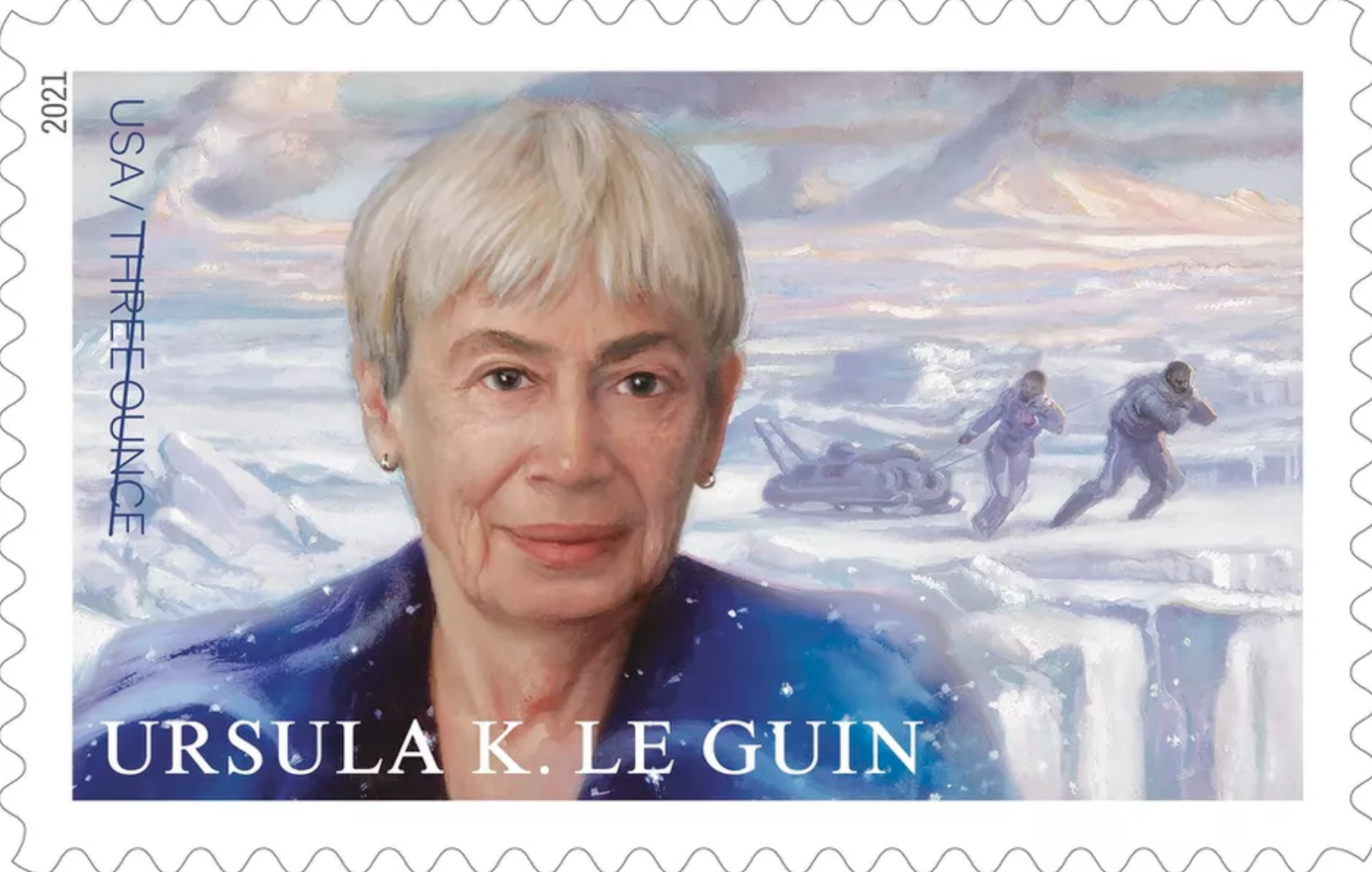
Ursula K. Le Guin Stamp Getting Released by the US Postal Service

Here’s one thing that’s going right with America’s decaying postal system. They write on the USPS web site: “The 33rd stamp in the Literary Arts series honors Ursula K. Le Guin (1929-2018), who expanded the scope of literature through novels and short stories that increased critical and popular appreciation of science fiction and fantasy. The stamp features a portrait of Le Guin based on a 2006 photograph. The background shows a scene from her landmark 1969 novel “The Left Hand of Darkness,” in which an envoy from Earth named Genly Ai escapes from a prison camp across the wintry planet of Gethen with Estraven, a disgraced Gethenian politician. The artist for this stamp was Donato Giancola. The art director was Antonio Alcalá. The words “three ounce” on this stamp indicate its usage value. Like a Forever stamp, this stamp will always be valid for the value printed on it.” The postal service has not said precisely when the stamp will be released.

Would you like to support the mission of Open Culture? Please consider making a donation to our site. It’s hard to rely 100% on ads, and your contributions will help us continue providing the best free cultural and educational materials to learners everywhere.

Also consider following Open Culture on Facebook and Twitter and sharing intelligent media with your friends. Or sign up for our daily email and get a daily dose of Open Culture in your inbox. 

Related Content:

Ursula K. Le Guin’s Daily Routine: The Discipline That Fueled Her Imagination

When Ursula K. Le Guin & Philip K. Dick Went to High School Together

Ursula K. Le Guin Names the Books She Likes and Wants You to Read

Ursula K. Le Guin Stamp Getting Released by the US Postal Service is a post from: Open Culture. Follow us on Facebook, Twitter, and Google Plus, or get our Daily Email. And don't miss our big collections of Free Online Courses, Free Online Movies, Free eBooksFree Audio Books, Free Foreign Language Lessons, and MOOCs.


from Open Culture https://ift.tt/2M2PaLw
via Ilumina

Comments

  1. What a beautiful tribute to Ursula K. Le Guin with this new USPS stamp release! Her stories have transported readers across worlds—and it shows the enduring power of mail as a creative medium. If you’re inspired by the tactile impact of a stamp, imagine sending your own custom postcards with that same personal touch. Platforms like Mail Pros USA make it easy to design, print, and mail targeted campaigns in minutes.

    ReplyDelete
  2. What a wonderful tribute to Ursula K. Le Guin’s legacy — the USPS stamp beautifully captures not only her portrait but also that evocative scene from The Left Hand of Darkness, where Genly Ai and Estraven journey across the frozen world of Gethen. It’s a powerful reminder of how physical mail stamps can celebrate storytelling and build connections across time and imagination.

    At Laguna Digital, we believe in the enduring impact of tangible communication. Whether it’s custom postcards, bespoke direct‑mail campaigns, or collectible commemorative mailouts, we design print pieces that resonate emotionally—just like a beloved stamp does. Celebrating literary icons through print is a form of storytelling in itself.

    Thanks for sharing this inspiring piece — it’s a perfect moment to honor literary history and creative mailing possibilities.

    ReplyDelete

Post a Comment

Popular posts from this blog

When Albert Einstein & Charlie Chaplin Met and Became Fast Famous Friends (1930)

Photo via Wikimedia Commons “You do not really understand something unless you can explain it to your grandmother,” goes a well-known quote attributed variously to Albert Einstein, Richard Feynman, and Ernest Rutherford. No matter who said it, “the sentiment… rings true,” writes Michelle Lavery , “for researchers in all disciplines from particle physics to ecopsychology.” As Feynman discovered during his many years of teaching , it could be “the motto of all professional communicators,” The Guardian ’s Russell Grossman writes , “and especially those who earn a living communicating the tricky business of science.” Einstein became one of the world’s great science communicators by choice, not necessity, and found ways to explain his complex theories to children and the elderly alike. But perhaps, if he’d had his way, he would rather have avoided words altogether, and preferred acrobatic feats of silent daring to get his message across. We might at least conclude so from his reverence f...

Howard Zinn’s Recommended Reading List for Activists Who Want to Change the World

Image by via Wikimedia Commons Back in college, I spotted A People’s History of the United States   in the bags and on the bookshelves of many a fellow undergraduate. By that time, Howard Zinn’s alternative telling of the American story had been popular reading material for a couple of decades, just as it presumably remains a couple more decades on. Even now, a dozen years after Zinn’s death, his ideas about how to approach U.S. history through non-standard points of view remain widely influential. Just last month, Radical Reads featured the reading list he originally drew up for the  Socialist Worker , pitched at “activists interested in making their own history.” Zinn’s recommendations naturally include the work of other historians, from Gary Nash’s Red, White and Black: The Peoples of Early America (“a pioneering work of ‘multiculturalism’ dealing with racial interactions in the colonial period”) to Vincent Harding’s There Is a River: The Black Struggle for ...

1,100 Delicate Drawings of Root Systems Reveals the Hidden World of Plants

We know that plants can inspire art. If you, personally, still require convincing on that point, just have a look at Elizabeth Twining’s Illustrations of the Natural Orders of Plants , the drawings of Ernst Heinrich Haeckel , Elizabeth Blackwell’s  A Curious Herbal , and Nancy Anne Kingsbury Wollstonecraft’s Specimens of the Plants and Fruits of the Island of Cuba — not to mention the paintings of Georgia O’ Keeffe — all previously featured here on Open Culture. But those works concern themselves only with plant life as it exists above ground. What goes on down below, underneath the soil? That you can see for yourself — and without having to pull up one of our fine flowering (or non-flowering) friends to do so — at Wageningen University’s online archive of root system drawings . “The outcome of 40 years of  root system excavations in Europe,” says that site, the collection contains 1,180 diagrams of species from  Abies alba (best known today as a kind of Christmas t...