Behold 84 Great Novels Reinterpreted as Modernist Postage Stamps

Ali Johnson and Jim Quail of Liverpool-based design studio Dorothy had a hit with their music-based graphicswhich recast seminal alternativepsychedelicelectronic, and post-punk albums as oversized postage stamps.

Now, they’ve turned their attention and knack for highly condensed visual responses to the realms of literature.

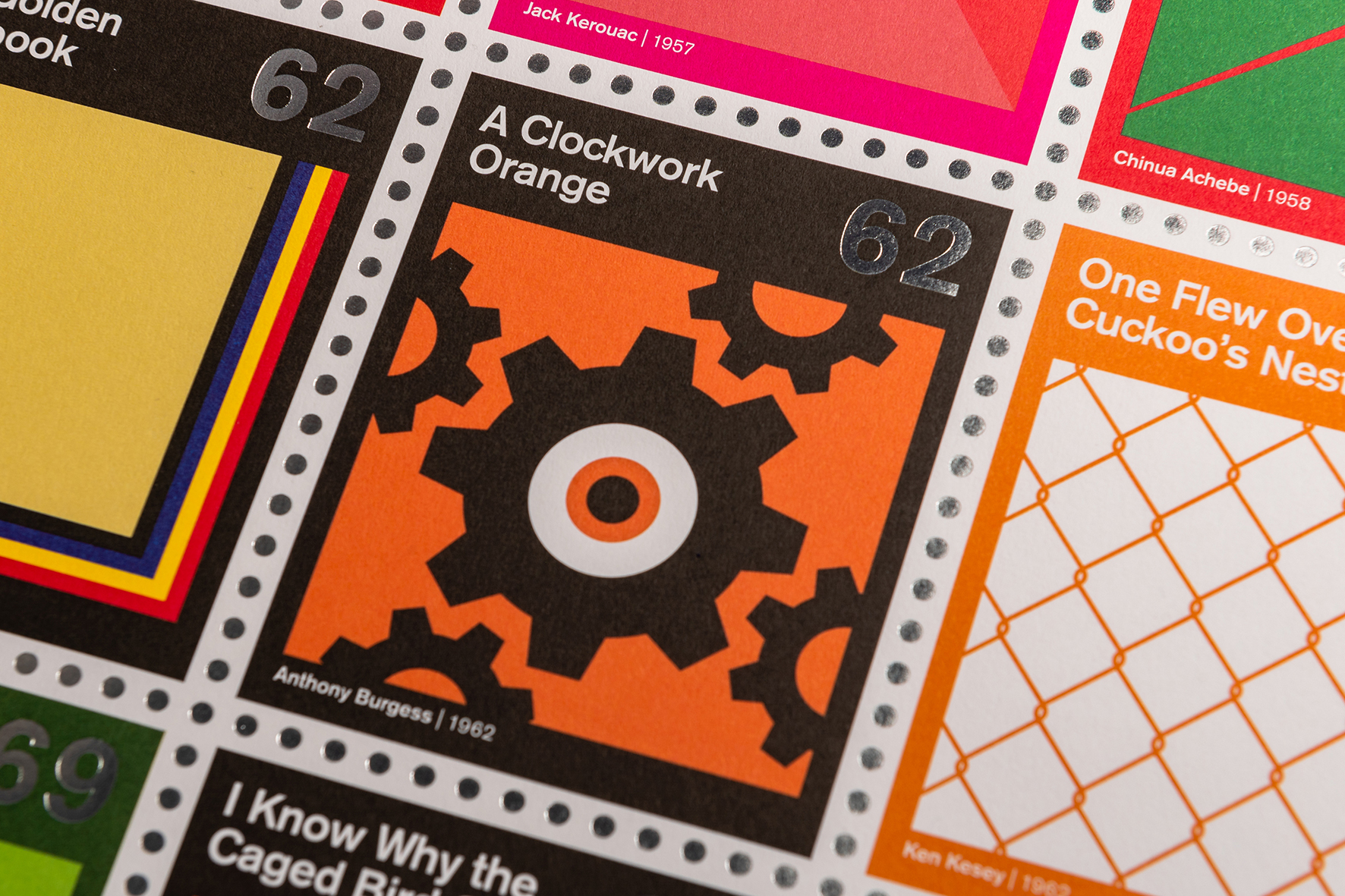
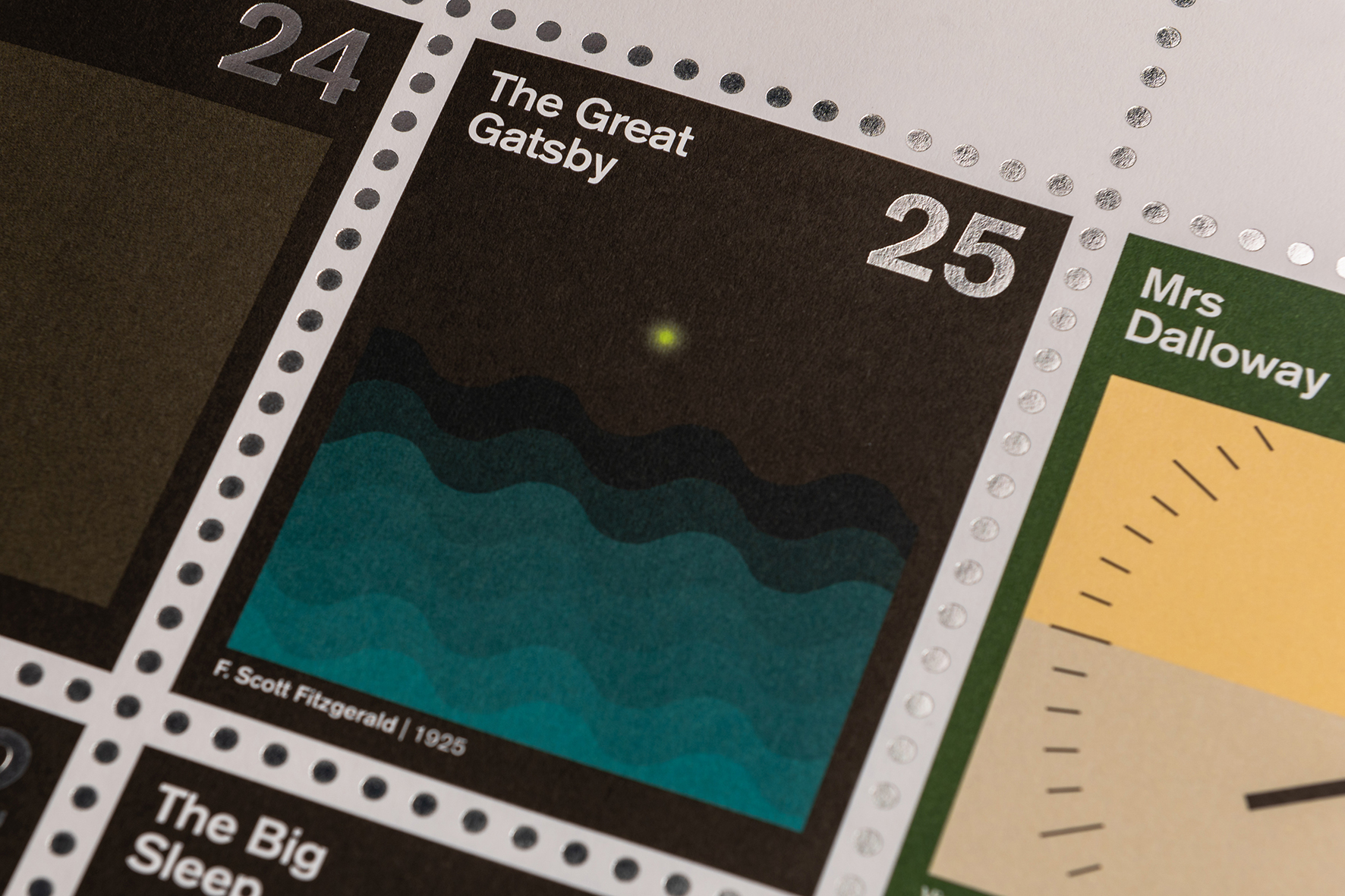
Their Modern Classics collection, above, synthesizes 42 titles into something emblematic and essential.

How many have you read?

How many would you be able to identify based on image alone?

It’s easy to grasp why the horizon figures prominently in On The RoadThe Grapes of Wrath, and The Road.

And understandably, the eyes have it when it comes to 1984A Clockwork Orange, and Slaughterhouse-Five.
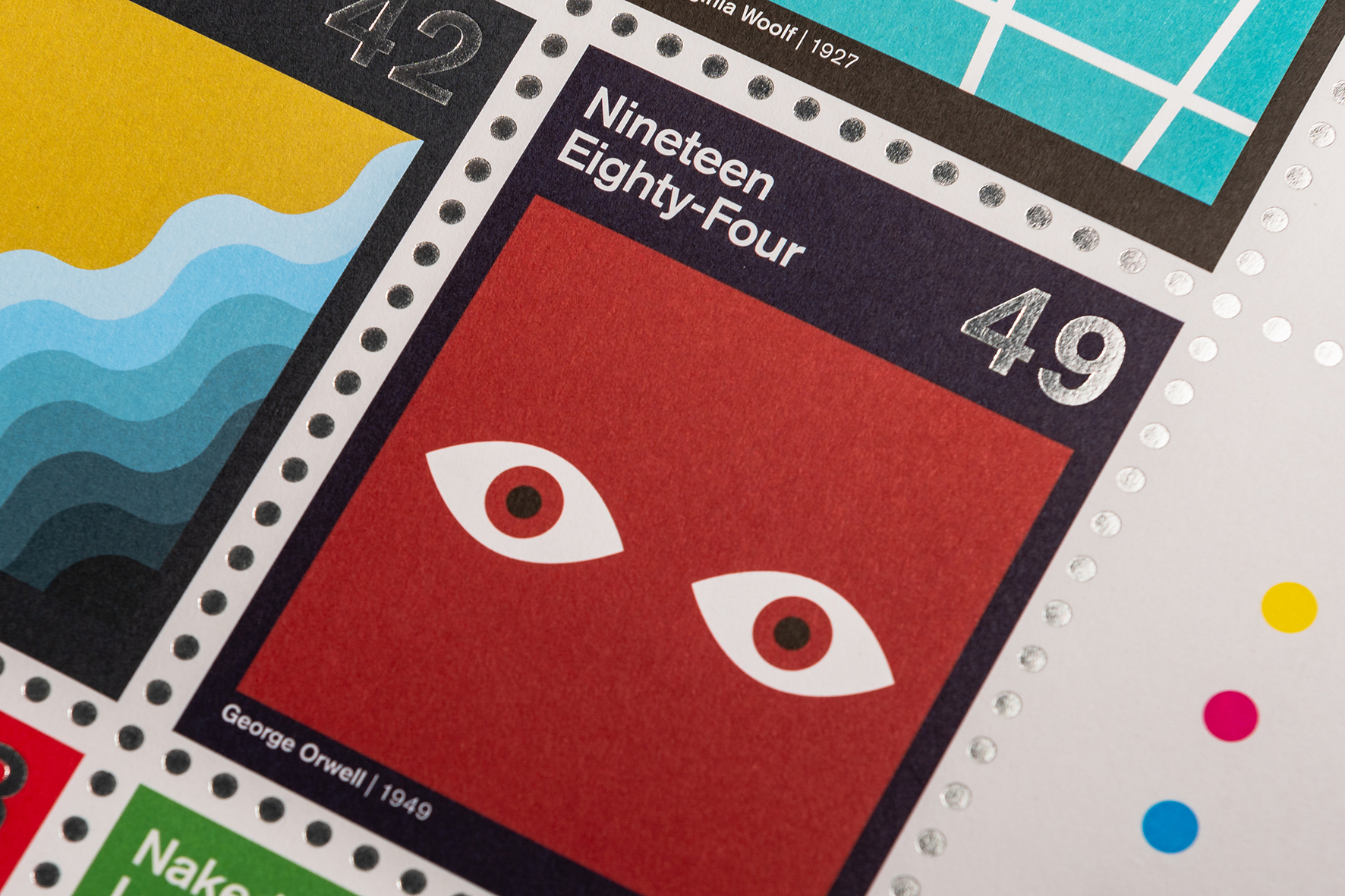
Elsewhere, the visual representations create connections that may take readers by surprise.

(Stay tuned for a master’s thesis that teases out thematic parallels between The Color Purple’s quilts and Holden Caulfield’s red hunting hat in The Catcher in the Rye.)

According to Johnson, she and Quail, avid readers both, fell out several times over which titles to include (and, by extension, exclude).

English teachers at middle and high school level will rejoice at the number of syllabus favorites that made the cut.

Potential stamp-themed creative assignments abound.
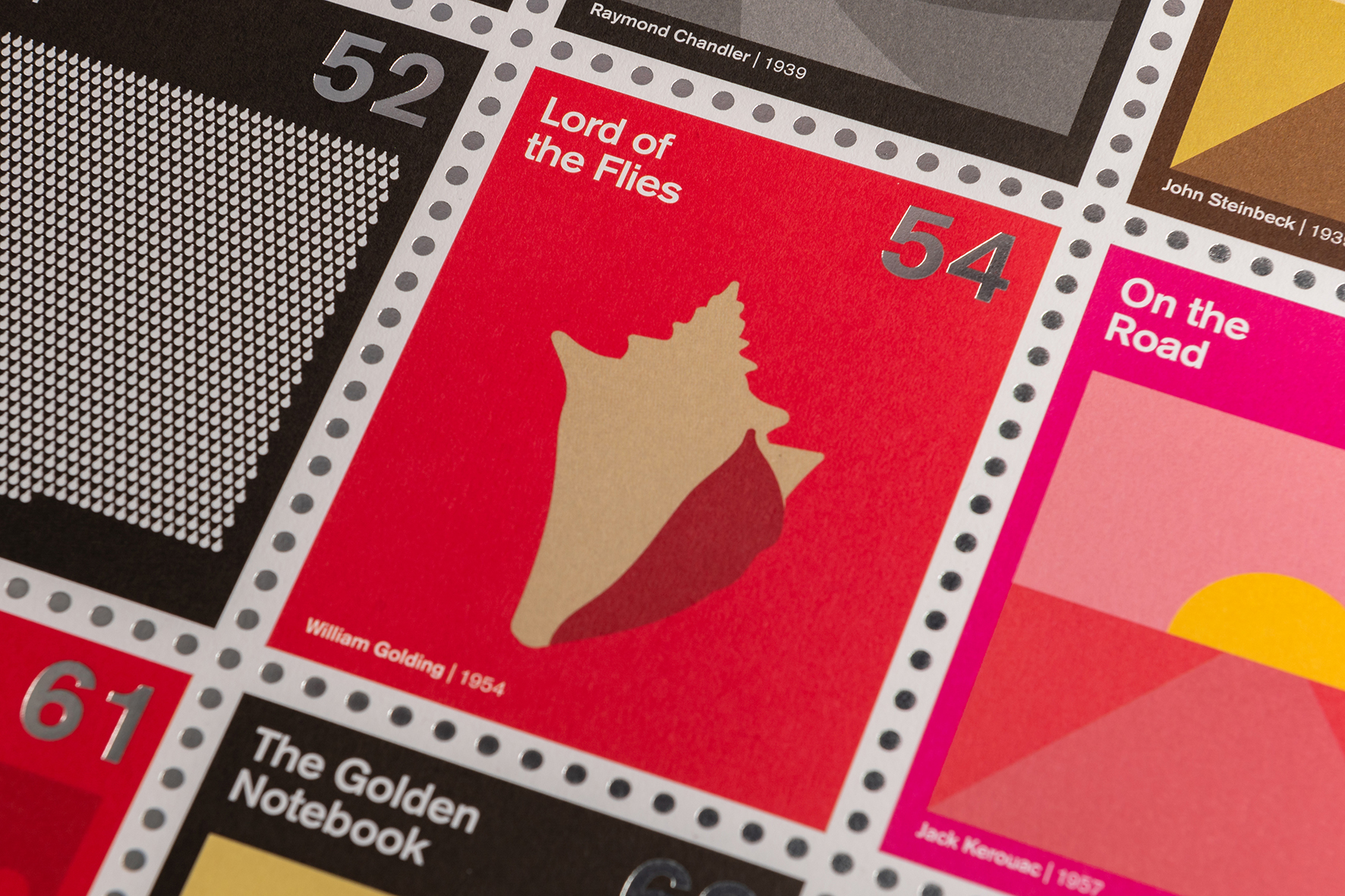
The conch may be an obvious choice for Lord of the Flies, but what of The Great Gatsby‘s green light?

Why not the eyes of Doctor T. J. Eckleburg?

swimming pool?

Or one of those beautiful shirts?

Discuss!

Then make your own stamp!

Students are far less likely to be conversant in the 42 earlier works comprising Dorothy’s literary Classics stamps, though musical and movie adaptations of Little WomenDracula, and Les Miserables should provide a toehold.

Our ignorance is such, we may need to reread Tess of the d’Urbervilles and Jane Eyre … or at least Google the significance of a spoon and all those orange and red triangles.

(Back in our pre-digital youth, Cliff’s Notes were the preferred Philistine option…)

Dorothy’s stamp prints of Classics and Modern Classics are available for purchase on their website.

Related Content: 

Good Movies as Old Books: 100 Films Reimagined as Vintage Book Covers

157 Animated Minimalist Mid-Century Book Covers

Classic Songs Re-Imagined as Vintage Book Covers During Our Troubled Times: “Under Pressure,” “It’s the End of the World as We Know It,” “Shelter from the Storm” & More

Ayun Halliday is the Chief Primaologist of the East Village Inky zine and author, most recently, of Creative, Not Famous: The Small Potato Manifesto.  Follow her @AyunHalliday.

Behold 84 Great Novels Reinterpreted as Modernist Postage Stamps is a post from: Open Culture. Follow us on Facebook and Twitter, or get our Daily Email. And don't miss our big collections of Free Online Courses, Free Online Movies, Free eBooksFree Audio Books, Free Foreign Language Lessons, and MOOCs.


from Open Culture https://ift.tt/3CCSG4B
via Ilumina

Comments

Popular posts from this blog

When Albert Einstein & Charlie Chaplin Met and Became Fast Famous Friends (1930)

Photo via Wikimedia Commons “You do not really understand something unless you can explain it to your grandmother,” goes a well-known quote attributed variously to Albert Einstein, Richard Feynman, and Ernest Rutherford. No matter who said it, “the sentiment… rings true,” writes Michelle Lavery , “for researchers in all disciplines from particle physics to ecopsychology.” As Feynman discovered during his many years of teaching , it could be “the motto of all professional communicators,” The Guardian ’s Russell Grossman writes , “and especially those who earn a living communicating the tricky business of science.” Einstein became one of the world’s great science communicators by choice, not necessity, and found ways to explain his complex theories to children and the elderly alike. But perhaps, if he’d had his way, he would rather have avoided words altogether, and preferred acrobatic feats of silent daring to get his message across. We might at least conclude so from his reverence f...

Howard Zinn’s Recommended Reading List for Activists Who Want to Change the World

Image by via Wikimedia Commons Back in college, I spotted A People’s History of the United States   in the bags and on the bookshelves of many a fellow undergraduate. By that time, Howard Zinn’s alternative telling of the American story had been popular reading material for a couple of decades, just as it presumably remains a couple more decades on. Even now, a dozen years after Zinn’s death, his ideas about how to approach U.S. history through non-standard points of view remain widely influential. Just last month, Radical Reads featured the reading list he originally drew up for the  Socialist Worker , pitched at “activists interested in making their own history.” Zinn’s recommendations naturally include the work of other historians, from Gary Nash’s Red, White and Black: The Peoples of Early America (“a pioneering work of ‘multiculturalism’ dealing with racial interactions in the colonial period”) to Vincent Harding’s There Is a River: The Black Struggle for ...

Zamrock: An Introduction to Zambia’s 1970s Rich & Psychedelic Rock Scene

The story of popular music in the late 20th century is never complete without an account of the explosive psychedelic rock, funk, Afrobeat, and other hybrid styles that proliferated on the African continent and across Latin American and the Caribbean in the 1960s and 70s. It’s only lately, however, that large audiences are discovering how much pioneering music came out of Kenya, Ghana, Nigeria, and other postcolonial countries, thanks to UK labels like Strut and Soundway (named by The Guardian as “one of the 10 British Labels defining the sound of 2014” and named “Label of the Year” in 2017). Germany’s Analogue Africa , a label that reissues classic albums from the era, puts it this way: “the future of music happened decades ago.” Only most Western audiences weren’t paying attention—with notable exceptions, of course: superstar drummer Ginger Baker apprenticed himself to Fela Kuti and became an evangelist for African drumming; Brian Eno and Talking Heads’ David Byrne ( who ...