
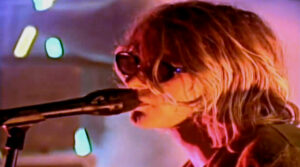

This month marks the 30th anniversary of Nirvana’s Nevermind, first released on September 24, 1991, “the day,” writes Michael Tedder at Stereogum, “that college radio-nurtured types and arty hard rock officially became rebranded as Alternative Rock, and, according to legend, everything changed forever.” You might believe that legend even if you remember the reality. Yes, “Smells Like Teen Spirit” was just as huge as everybody says — and, yes, you likely recall where you were when you first saw the video or heard the song explode with Pixies-inspired quiet-loud ferocity from the radio. But the change was already on the way.
Nirvana emerged in a pop music landscape slowly becoming saturated with alternative music. You might also remember where you were the first time you saw the video for Depeche Mode’s “Enjoy the Silence,” for example, or R.E.M.’s “Losing My Religion,” or Sinéad O’Connor’s “Nothing Compares 2 U” — or when you first experienced the dynamic/melodic assault of the aforementioned Pixies, virtual alt-rock elders by the time they released Trompe Le Monde, their fourth studio album, in the same September week that Nevermind appeared. (You may remember where you were the first time you heard the word “Lollapalooza,” first organized in 1991.)
The fateful week in September also saw the release of 90s-defining albums like Primal Scream’s Screamadelica, Red Hot Chili Peppers’ Blood Sugar Sex Magik, and A Tribe Called Quest’s Low End Theory. In the year that Nevermind supposedly single-handedly invented “grunge,” Soundgarden released Badmotorfinger and Pearl Jam released Ten. It’s fair to say Nirvana were one of just many bands reinventing themselves and the culture. Even the hair metal bands and teen pop idols Nirvana put out of business were already trying to make more serious, “authentic” music before Nevermind turned every executive’s head.
Kurt Cobain was already well aware — and wary — of the dangers of hero worship and blind allegiance to style over substance. It was an attitude he came by naturally given that, in 1991, his friends in Olympia, Washington founded an indie record label called Kill Rock Stars. He’d written an anthem, “In Bloom,” about it before anyone heard the opening power chords of “Smells Like Teen Spirit.” As he pursued, with rigorous ambition, the power of rock stardom, he rejected its trappings and pretensions, as when the band appeared on Top of the Pops and took the piss out of the show, rather than mime along dutifully, as Mark Beaumont writes at NME:
Pretending to strum his guitar like a robot and making no attempt to go anywhere near an actual chord – presumably a statement about being asked to perform like a mechanical puppet – Kurt launches into his vocal in deep, theatrical baritone, an homage to Morrissey that comes across more like Jim Morrison on mogadon. Meanwhile Krist Novoselic flails his bass around his head like he’s wrestling a live wolf and Dave Grohl’s ‘drumming’ is more like an interpretive dance to represent ‘goofy imp’. Oh, and heaven knows what the TOTP censors thought of Kurt changing the opening lyrics to “load up on drugs, kill your friends” before trying to eat the microphone.
In light of the groundswell of alternative bands emerging — or still plugging away — at the time of Nevermind’s release, the myth of Nirvana as the single-handed inventors of 90s alt-rock is more than a little overblown. This is especially so in a decade that saw electronic dance music and hip hop cross over into rock and vice-versa, a trend Nirvana had nothing to do with. They were a thunderingly great band, and Kurt Cobain was a rare and gifted songwriter, but the heart of Nirvana’s popular appeal was extra-musical. The band — meaning, principally, Cobain — most honestly embodied the spirit of the time: painfully ambivalent and at war with its aspirations. “Kurt — I would call him a windmill,” says bassist Krist Novoselic. “He wanted to be a rock star — and he hated it.”
Related Content:
The Recording Secrets of Nirvana’s Nevermind Revealed by Producer Butch Vig
The Ukulele Orchestra of Great Britain’s Headbanging Cover of Nirvana’s “Smells Like Teen Spirit”
Josh Jones is a writer and musician based in Durham, NC. Follow him at @jdmagness
Nirvana Refuses to Mime Along to “Smells Like Teen Spirit” on Top of the Pops (1991) is a post from: Open Culture. Follow us on Facebook and Twitter, or get our Daily Email. And don't miss our big collections of Free Online Courses, Free Online Movies, Free eBooks, Free Audio Books, Free Foreign Language Lessons, and MOOCs.


from Open Culture https://ift.tt/3ihMB5q
via Ilumina
Comments
Post a Comment