
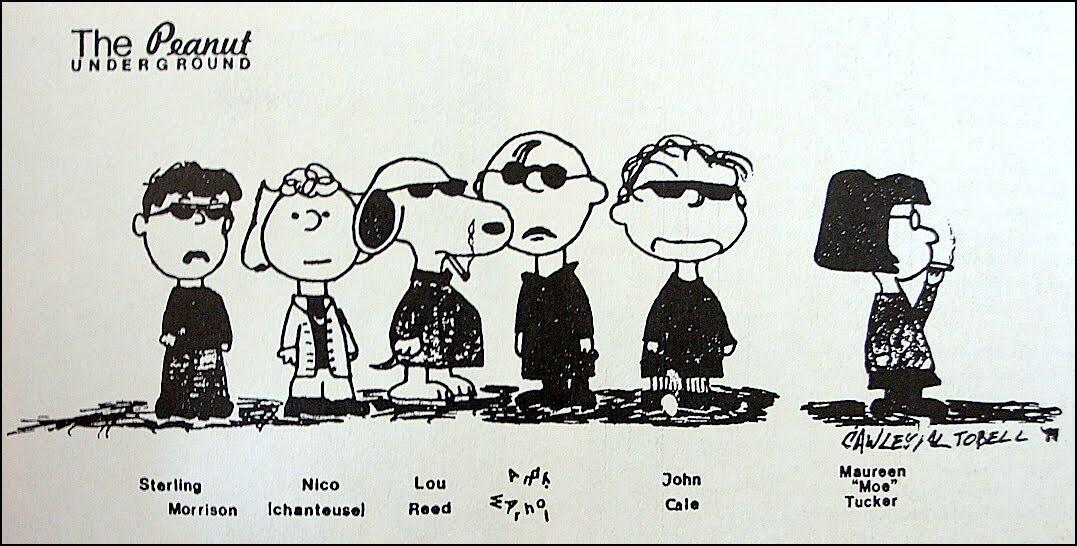
The Velvet Underground as Peanuts Characters: Snoopy Morphs Into Lou Reed, Charlie Brown Into Andy Warhol
peanut underground

The fun cartoon above was apparently found in a "Guide to the Velvet Underground and Andy Warhol's Factory" published by the French magazine, Les Inrockuptibles in 1990. It came around the same time the Fondation Cartier pour l'art contemporain (located in Paris) held an exhibition dedicated to Andy Warhol. Of course, Warhol famously took a break from painting in the mid-1960s and, among other things, threw his influence behind the up-and-coming NYC band, The Velvet Underground. Serving as the band's manager, he "produced" VU's first album, which meant designing the album cover and giving the band members -- Lou Reed, John Cale, Sterling Morrison, Maureen Tucker and Nico -- the freedom to make whatever album they pleased, up to a certain point. Above, you can see these same musicians reimagined as Peanuts characters.

Would you like to support the mission of Open Culture? Please consider making a donation to our site. It's hard to rely 100% on ads, and your contributions will help us continue providing the best free cultural and educational materials to learners everywhere.

Also consider following Open Culture on Facebook and Twitter and sharing intelligent media with your friends. Or sign up for our daily email and get a daily dose of Open Culture in your inbox. 

Related Content:

The Velvet Underground Captured in Color Concert Footage by Andy Warhol (1967)

Andy Warhol Explains Why He Decided to Give Up Painting & Manage the Velvet Underground Instead (1966)

A Symphony of Sound (1966): Velvet Underground Improvises, Warhol Films It, Until the Cops Turn Up

The Velvet Underground as Peanuts Characters: Snoopy Morphs Into Lou Reed, Charlie Brown Into Andy Warhol is a post from: Open Culture. Follow us on Facebook, Twitter, and Google Plus, or get our Daily Email. And don't miss our big collections of Free Online Courses, Free Online Movies, Free eBooksFree Audio Books, Free Foreign Language Lessons, and MOOCs.


from Open Culture https://ift.tt/372us4g
via Ilumina

Comments

Popular posts from this blog

When Albert Einstein & Charlie Chaplin Met and Became Fast Famous Friends (1930)

Photo via Wikimedia Commons “You do not really understand something unless you can explain it to your grandmother,” goes a well-known quote attributed variously to Albert Einstein, Richard Feynman, and Ernest Rutherford. No matter who said it, “the sentiment… rings true,” writes Michelle Lavery , “for researchers in all disciplines from particle physics to ecopsychology.” As Feynman discovered during his many years of teaching , it could be “the motto of all professional communicators,” The Guardian ’s Russell Grossman writes , “and especially those who earn a living communicating the tricky business of science.” Einstein became one of the world’s great science communicators by choice, not necessity, and found ways to explain his complex theories to children and the elderly alike. But perhaps, if he’d had his way, he would rather have avoided words altogether, and preferred acrobatic feats of silent daring to get his message across. We might at least conclude so from his reverence f...

1,100 Delicate Drawings of Root Systems Reveals the Hidden World of Plants

We know that plants can inspire art. If you, personally, still require convincing on that point, just have a look at Elizabeth Twining’s Illustrations of the Natural Orders of Plants , the drawings of Ernst Heinrich Haeckel , Elizabeth Blackwell’s  A Curious Herbal , and Nancy Anne Kingsbury Wollstonecraft’s Specimens of the Plants and Fruits of the Island of Cuba — not to mention the paintings of Georgia O’ Keeffe — all previously featured here on Open Culture. But those works concern themselves only with plant life as it exists above ground. What goes on down below, underneath the soil? That you can see for yourself — and without having to pull up one of our fine flowering (or non-flowering) friends to do so — at Wageningen University’s online archive of root system drawings . “The outcome of 40 years of  root system excavations in Europe,” says that site, the collection contains 1,180 diagrams of species from  Abies alba (best known today as a kind of Christmas t...

Zamrock: An Introduction to Zambia’s 1970s Rich & Psychedelic Rock Scene

The story of popular music in the late 20th century is never complete without an account of the explosive psychedelic rock, funk, Afrobeat, and other hybrid styles that proliferated on the African continent and across Latin American and the Caribbean in the 1960s and 70s. It’s only lately, however, that large audiences are discovering how much pioneering music came out of Kenya, Ghana, Nigeria, and other postcolonial countries, thanks to UK labels like Strut and Soundway (named by The Guardian as “one of the 10 British Labels defining the sound of 2014” and named “Label of the Year” in 2017). Germany’s Analogue Africa , a label that reissues classic albums from the era, puts it this way: “the future of music happened decades ago.” Only most Western audiences weren’t paying attention—with notable exceptions, of course: superstar drummer Ginger Baker apprenticed himself to Fela Kuti and became an evangelist for African drumming; Brian Eno and Talking Heads’ David Byrne ( who ...