The Mueller Report Released as a Free Well-Formatted eBook

Boing Boing writes: "Back in April, Andrew Albanese from Publishers Weekly wrote a column deploring the abysmal formatting in the DoJ's release of the Mueller Report, and publicly requesting that the Digital Public Library of America produce well-formatted ebook editions, which they have now done!"

The Digital Public Library of America adds:

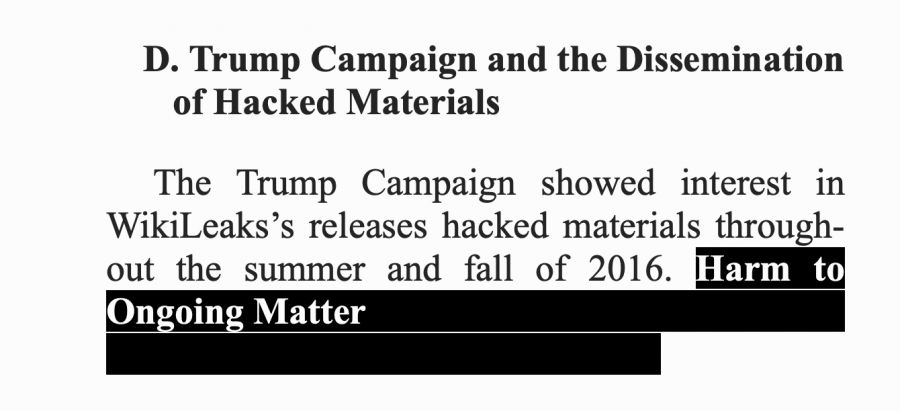
The Report On The Investigation Into Russian Interference In The 2016 Presidential Election, or the Mueller Report, is now freely available in ebook format to read on your phone or tablet from DPLA’s website and the Open Bookshelf collection. The Mueller report was released to the public by the Department of Justice as a PDF last month, initially in a format that was not text-searchable. By making the report available as an ebook in our Open Bookshelf collection, anyone can download and read it for free, all in the SimplyE app - no library card or sign in required.

One of the primary objectives of DPLA’s ebooks work is to make the best openly-licensed e-content available to libraries and their patrons. For libraries offering New York Public Library’s SimplyE app, the Mueller Report can be easily integrated into the ebook offerings made available to their patrons. SimplyE and Open Bookshelf are freely available to anyone with an iOS or Android device.

Read the Mueller Report today

Download on the web: Visit https://muellerreport.dp.la, download it in one click, and read it with your computer’s e-reader like iBooks.

Read in SimplyE on your phone or tablet:

  1. Download the SimplyE app to your iOS or Android device.

  2. Use the library selector icon in the upper left corner, select Manage Accounts, then Add Library, and select Digital Public Library of America.

  3. Find the Mueller Report in the top row.

To learn more about Open Bookshelf and other DPLA ebooks offerings, visit https://ebooks.dp.la. DPLA’s Ebook work and the production of the Mueller Report ebook is supported by the Alfred P. Sloan Foundation.

You can also download The Mueller Report in an epub version here.

Would you like to support the mission of Open Culture? Please consider making a donation to our site. It's hard to rely 100% on ads, and your contributions will help us continue providing the best free cultural and educational materials to learners everywhere.

Also consider following Open Culture on Facebook and Twitter and sharing intelligent media with your friends. Or sign up for our daily email and get a daily dose of Open Culture in your inbox. 

via Boing Boing

Related Content

1,000 Free Audio Books: Download Great Books for Free

800 Free eBooks for iPad, Kindle & Other Devices

1,300 Free Online Courses from Top Universities

1,150 Free Movies Online: Great Classics, Indies, Noir, Westerns, etc.


The Mueller Report Released as a Free Well-Formatted eBook is a post from: Open Culture. Follow us on Facebook, Twitter, and Google Plus, or get our Daily Email. And don't miss our big collections of Free Online Courses, Free Online Movies, Free eBooks, Free Audio Books, Free Foreign Language Lessons, and MOOCs.


from Open Culture http://bit.ly/2Mabv9y
via Ilumina

Comments

Popular posts from this blog

What Voltaire Meant When He Said That “We Must Cultivate Our Garden”: An Animated Introduction

“Voltaire’s goal in writing [his 1759 satire Candide ] was to destroy the optimism of his times,” says Alain de Botton in the School of Life video above, “an optimism that centered around science, love, technical progress, and a faith in reason.” These beliefs were folly, Voltaire thought: the transfer of faith from a providential God to a perfect, clockwork universe. Candide satirizes this happy rationalism in Doctor Pangloss, whose belief that ours is the best of possible worlds comes directly from the philosophical optimism of Gottfried Leibniz . The preponderance of the evidence, Voltaire made abundantly clear in the novel’s series of increasingly horrific episodes, points toward a blind, indifferent universe full of needless cruelty and chaos. “Hope was, he felt, a disease,” de Botton says, and “it was Voltaire’s generous goal to try and cure us of it.” But as everyone who has read Candide (or read a summary or brief notes on Candide ) knows, the novel does not end with ...

When Albert Einstein & Charlie Chaplin Met and Became Fast Famous Friends (1930)

Photo via Wikimedia Commons “You do not really understand something unless you can explain it to your grandmother,” goes a well-known quote attributed variously to Albert Einstein, Richard Feynman, and Ernest Rutherford. No matter who said it, “the sentiment… rings true,” writes Michelle Lavery , “for researchers in all disciplines from particle physics to ecopsychology.” As Feynman discovered during his many years of teaching , it could be “the motto of all professional communicators,” The Guardian ’s Russell Grossman writes , “and especially those who earn a living communicating the tricky business of science.” Einstein became one of the world’s great science communicators by choice, not necessity, and found ways to explain his complex theories to children and the elderly alike. But perhaps, if he’d had his way, he would rather have avoided words altogether, and preferred acrobatic feats of silent daring to get his message across. We might at least conclude so from his reverence f...

1,100 Delicate Drawings of Root Systems Reveals the Hidden World of Plants

We know that plants can inspire art. If you, personally, still require convincing on that point, just have a look at Elizabeth Twining’s Illustrations of the Natural Orders of Plants , the drawings of Ernst Heinrich Haeckel , Elizabeth Blackwell’s  A Curious Herbal , and Nancy Anne Kingsbury Wollstonecraft’s Specimens of the Plants and Fruits of the Island of Cuba — not to mention the paintings of Georgia O’ Keeffe — all previously featured here on Open Culture. But those works concern themselves only with plant life as it exists above ground. What goes on down below, underneath the soil? That you can see for yourself — and without having to pull up one of our fine flowering (or non-flowering) friends to do so — at Wageningen University’s online archive of root system drawings . “The outcome of 40 years of  root system excavations in Europe,” says that site, the collection contains 1,180 diagrams of species from  Abies alba (best known today as a kind of Christmas t...